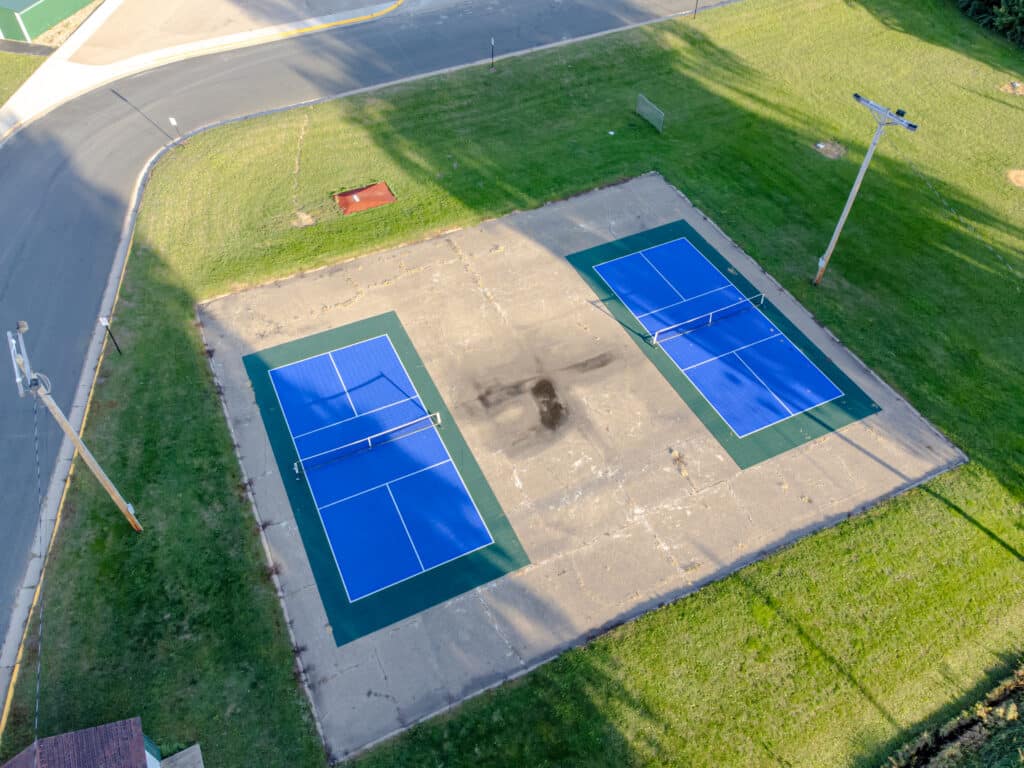
How to paint pickleball lines starts with the rectangle, not the paint: lay out and square the 44 by 20 ft (13.41 by 6.10 m) court first, then paint the kitchen line before the center line behind it. USA Pickleball sets the 2 in (5.08 cm) line width as a recommendation, but requires every line to be one color that clearly contrasts with the surface.
Court diagram

Full pickleball line layout dimensions
Every figure below comes from Rules 3.A and 3.B of the 2026 USA Pickleball Official Rulebook, already sourced on this site’s pickleball court dimensions guide. The diagonal rows are not printed in the rulebook; they are calculated from those official figures with the Pythagorean theorem and labeled as derived calculations.
| Measurement | Figure | Applies to | Status |
|---|---|---|---|
| Court length | 44 ft (13.41 m) | Singles and doubles | Official rule |
| Court width | 20 ft (6.10 m) | Singles and doubles | Official rule |
| Kitchen line, net to non-volley zone line | 7 ft (2.13 m) | Each end of the court | Official rule |
| Service court depth, kitchen line to baseline | 15 ft (4.57 m) | Each of the four service courts | Derived calculation |
| Service court width, sideline to center line | 10 ft (3.05 m) | Each of the four service courts | Derived calculation |
| Line width | 2 in (5.08 cm) | All court lines | Recommendation |
| Full court diagonal (squaring check) | 48 ft 4 in (14.73 m) | Whole court, corner to corner | Derived calculation |
| Service court diagonal (squaring check) | 18 ft 0.3 in (5.49 m) | Each of the four service courts | Derived calculation |
Lay out the rectangle before any line goes down
A rectangle is easiest to fix from its corners, not by chasing one line at a time. Stretch a string line long enough to pass both ends of where the net will stand, and mark its center point. From that center point, measure out half the court width, 10 ft (3.05 m), to each side; rule 3.B.5 confirms the same figure by placing the net’s center 10 ft from the outside edge of each sideline. From each of those two points, run a second string the full 44 ft (13.41 m) court length and mark the opposite corner at that distance, repeating from the other end so all four corners come from the same two reference measurements: half-width and length.
Only after all four corners are fixed should any other line go down. Rule 3.A.2 takes every court dimension to the outside edge of the painted lines, so the four corner points mark the outer edge of the rectangle, not the center of a future stripe. Setting the line’s outer edge on that surveyed point, rather than centering the stripe over it, keeps the full 44 by 20 ft of playing surface instead of shrinking it by the width of the paint.
Square the court with the diagonal, twice
Four correct side lengths do not prove a square court; a rectangle can lean into a parallelogram while every side still measures 44 or 20 ft. The reliable check is the diagonal, corner to opposite corner. On the whole 44 by 20 ft rectangle that diagonal is 48 ft 4 in (14.73 m). If a measured diagonal does not match that figure, at least one corner is out of square, even when every side reads correctly on its own.
Once the kitchen and center lines are also down, each of the four service courts, 15 by 10 ft, can be squared on its own with a shorter diagonal of 18 ft 0.3 in (5.49 m). Checking the smaller rectangle catches an error the outer diagonal alone can miss: a center line painted a few inches off its mark can leave the full court diagonal correct while one service court is not a true rectangle. Neither diagonal is printed in the USA Pickleball rulebook; both are this page’s own arithmetic from the official court dimensions.
Paint the kitchen line before the center line
The non-volley zone line, the kitchen line, can go down as soon as the four corners are fixed. Rule 3.A.4.c sets it parallel to the net, 7 ft (2.13 m) from it, running the full 20 ft width between the sidelines at each end; every measurement it needs comes directly off the corner points already on the ground.
The center line depends on the kitchen line, so it has to come after. It runs from the kitchen line back to the baseline, splitting each 15 by 10 ft service court area in half, and it does not continue into the non-volley zone itself. Painting the kitchen line first fixes the point where the center line has to stop; painting the center line first would leave that stopping point unmarked until the kitchen line arrives behind it. The rulebook does not state the center line’s own length directly: at 15 ft, it matches the service court depth in the table above, a figure this page derives rather than quotes.
Line width is a recommendation; the color rule is not
Rule 3.A.4.e sets the 2 in (5.08 cm) line width with the word “should,” not “must.” A court painted with a narrower or wider line within reason is still a legal pickleball court; the rulebook does not fail a court over the exact stripe width the way it would over a short baseline.
The same rule is firmer about color: every line on the court has to be a single color that clearly contrasts with the playing surface. That requirement is why a court built over existing lines from another sport commonly gets its pickleball lines in a second color instead of reusing white; two sets of white lines on one surface would each fail the rule’s own contrast test against the other. The pickleball-on-a-tennis-court guide covers how many courts fit when lines are added to an existing tennis court rather than a bare surface.
Overhead plan
The same surface seen from straight above, drawn to scale. Nothing is foreshortened here, so every figure can be read off the drawing the way a tape measure would take it.

Detail sheet
A rule book fixes more than the shape of the surface, and the rest of it is too small to draw at court scale: a mark a few centimeters long, a post standing a meter off the sideline, the clearance around the whole thing. Each one here has its own frame and its own scale.

Frequently asked questions
What width should pickleball court lines be painted?
USA Pickleball rule 3.A.4.e sets 2 in (5.08 cm) for all court lines, but words it as a recommendation rather than a requirement. A court is still regulation if its lines are painted at a slightly different width.
Do pickleball court lines have to be a specific color?
Not a specific color, but rule 3.A.4.e does require every line on the court to be one color that clearly contrasts with the playing surface. White, yellow, and other high-contrast colors all satisfy the rule as long as the surface underneath is a different shade.
Which line should be painted first on a pickleball court?
The four corners of the 44 by 20 ft rectangle come first, fixed from string lines and checked with the diagonal. The kitchen line goes down next, since it is set directly off the net and the corners. The center line comes last, because it stops where the kitchen line already runs.
How do I check that a pickleball court is painted square?
Measure the full diagonal, corner to opposite corner: it should read 48 ft 4 in (14.73 m). Each individual service court, 15 by 10 ft, can also be checked on its own with a diagonal of 18 ft 0.3 in (5.49 m). Matching side lengths alone do not prove the corners are square.
Can pickleball lines share a color with existing court lines?
No, not if those existing lines stay on the surface. Rule 3.A.4.e requires every pickleball line to contrast clearly with the surface, and two sets of lines in the same color would not contrast with each other, which is why converted courts typically add pickleball lines in a second color.
Official sources
- USA Pickleball, 2026 USA Pickleball Official Rulebook, 2026 edition, Section 3, Court and Equipment, rules 3.A and 3.B. Source of every official figure here, already verified September 5, 2026 for this site’s pickleball court dimensions guide.
Diagonal measurements checked against these dimensions on 27 October 2026. The methodology page explains how each figure is labeled as a rule or a derived calculation; report an error through corrections.