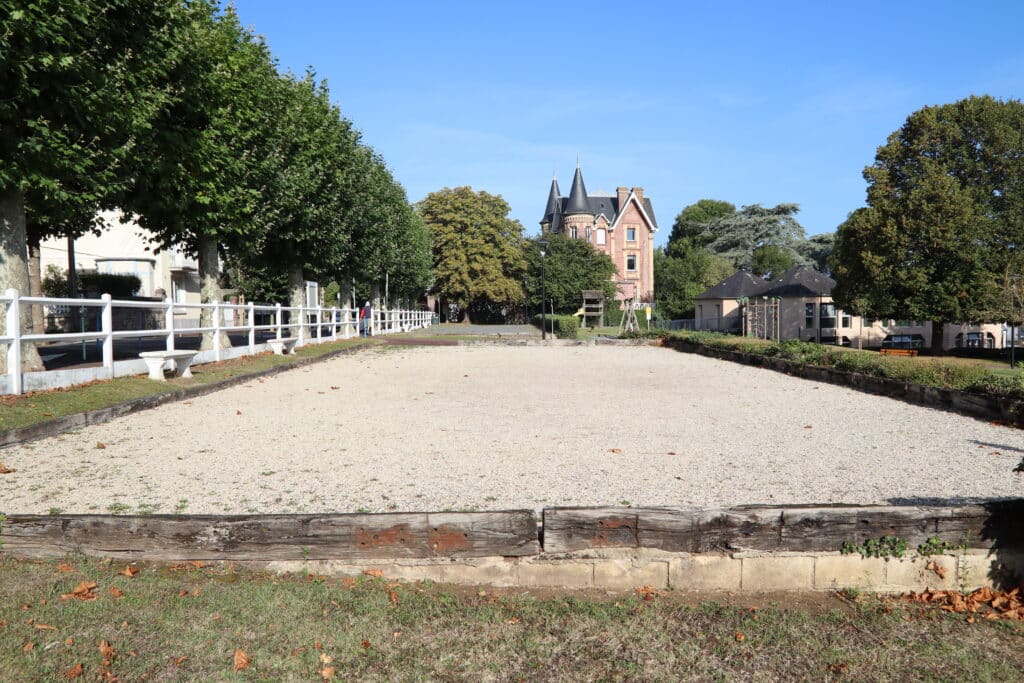
Bocce vs pétanque comparisons usually stop at the balls, but the two sports’ courts differ even more. A regulation bocce court is a fixed, walled lane: 86.92 ft (26.49 m) long and 13.12 ft (4.00 m) wide under USBF Open Rules. Pétanque needs no court at all. FIPJP rules only require a marked terrain, 15 x 4 m minimum, when a competition’s organizers or an umpire call for one. The drawing on this page shows that open pétanque terrain, not a boxed bocce alley; this atlas has no separate bocce hub to draw one.
Court diagram

Full court dimensions compared
Every bocce figure below comes from the United States Bocce Federation’s Open Rules, updated March 23, 2023. Every pétanque figure comes from the FIPJP’s Official Rules for the Sport of Pétanque, approved December 2020 and effective since January 1, 2021, the same edition this site’s pétanque guide cites. Rows marked Derived calculation are court areas this page multiplied out; neither federation publishes them directly.
| Measurement | Figure | Applies to | Status |
|---|---|---|---|
| Fixed court required | No; played on any surface unless a competition’s organizers or an umpire require a marked terrain | Pétanque, FIPJP Article 5 | Official rule |
| Marked terrain, National / International | 15 m (49 ft 3 in) long x 4 m (13 ft 1 in) wide, minimum | Pétanque, FIPJP Article 5 | Official rule |
| Marked terrain, other competitions | 12 m (39 ft 4 in) long x 3 m (9 ft 10 in) wide, minimum | Pétanque, FIPJP Article 5 | Official rule |
| Terrain area, National / International minimum | 60 sq m (645.83 sq ft) | Pétanque | Derived calculation |
| Official court | 86.92 ft (26.49 m) long x 13.12 ft (4.00 m) wide | Bocce, USBF Open Rules | Official rule |
| Court area, official court | 1,140.39 sq ft (105.95 sq m) | Bocce | Derived calculation |
| Boundary, when enclosed | Barriers kept at least 1 m (3 ft 3 in) from the terrain’s outer line; not part of play | Pétanque, FIPJP Article 5 | Official rule |
| Boundary | Raised side boards and a back wall bound the court and are legal targets for a bank shot | Bocce, USBF Open Rules | Official rule |
| Surface | Any surface; a marked terrain is usually gravel, dirt or sand | Pétanque | Official rule |
| Surface | Varies by facility: carpet, crushed stone, dirt, oyster shell, clay or synthetic carpet | Bocce, USBF Open Rules | Official rule (range) |
A boxed court vs a terrain that doesn’t have to exist
Every other sport on this site starts from a fixed, dimensioned court. Bocce does too: an official court under USBF rules is a walled lane, and its side boards are part of the game. A bocce ball can bank off them on purpose, the way a billiards shot works a rail. Pétanque’s FIPJP Article 5 opens with the opposite instruction: pétanque is played on any surface, and a dimensioned terrain only appears when a competition’s organizers or an umpire ask for one. Club and backyard pétanque happens on open gravel, dirt or grass with no boundary at all. Even when a pétanque terrain is enclosed, Article 5 keeps the barrier a full meter away from the terrain’s outer line, so it cannot be banked off the way a bocce side board can. The full terrain rules, including the throwing circle and the jack’s legal range, are on this site’s pétanque hub.
Two different ways to start a throw
Bocce and pétanque set up the throw itself differently too. A bocce player points or shoots from behind a single foul line, which the USBF recommends setting 13 ft (3.96 m) from the back wall; a foot may touch that line but not cross it fully before the ball is released. A pétanque player instead stands with both feet together inside a circle, drawn 35 to 50 cm across or a rigid 50 cm template, and under FIPJP Article 6 may not lift either foot or leave the circle until the thrown boule comes to rest. One sport draws a line to throw from. The other draws a ring to stand in.
The balls aren’t close in size either
A pétanque boule has to be metal, hollow, and between 7.05 cm and 8 cm (2.78 in to 3.15 in) across, weighing 650 to 800 g (1.43 to 1.76 lb), under FIPJP Article 2; players 11 and under may use a smaller approved 65 mm, 600 g ball. The USBF’s tournament standard for a bocce ball is 106 to 107 mm (4.17 to 4.21 in) across and 900 to 920 g (1.98 to 2.03 lb), noticeably larger and heavier, though the USBF’s rule text doesn’t say what the ball has to be made of, only its size and weight. The two sports’ target balls differ as well. FIPJP’s jack, called the cochonnet, is wood or synthetic, exactly 30 mm (tolerance 1 mm) across and 10 to 18 g, under Article 3, and the pétanque dimensions guide on this site already covers how far it has to be thrown, 6 to 10 m from the circle for adults. The USBF rule book names its own target ball the pallino and states only where it has to land, between the center line and the far foul line, not how big it is or how far it travels.
Where the rule sets differ
| Figure | Bocce (USBF) | Pétanque (FIPJP) |
|---|---|---|
| Fixed court required | Yes, every official court | No, only when a competition calls for one |
| Official size | 86.92 x 13.12 ft (26.49 x 4.00 m) | 15 x 4 m minimum (National/International); as small as 12 x 3 m otherwise |
| Boundary | Raised side boards and back wall, part of play | Open edge, or a barrier kept 1 m back, not part of play |
| Starting position | Behind a foul line, 13 ft from the back wall | Inside a circle, 35-50 cm drawn or a rigid 50 cm template |
| Ball size and weight | 106-107 mm, 900-920 g | 70.5-80 mm, 650-800 g (metal, hollow) |
| Target ball | Pallino; landing zone set, size not published | Jack (cochonnet); 30 mm, 10-18 g, thrown 6-10 m |
Overhead plan
The same surface seen from straight above, drawn to scale. Nothing is foreshortened here, so every figure can be read off the drawing the way a tape measure would take it.

Detail sheet
A rule book fixes more than the shape of the surface, and the rest of it is too small to draw at court scale: a mark a few centimeters long, a post standing a meter off the sideline, the clearance around the whole thing. Each one here has its own frame and its own scale.

Frequently asked questions
Are bocce and pétanque the same game?
No. Both belong to the wider family of boules target games, but their equipment and courts are governed by different rule books. A pétanque boule is a smaller, hollow metal ball thrown from inside a standing circle, while a bocce ball is larger and heavier and is rolled or shot from behind a foul line on a walled court.
Do you need a court to play pétanque?
No. FIPJP Article 5 states that pétanque is played on any surface, and a marked, dimensioned terrain is only required when a competition’s organizers or an umpire call for one. Bocce has no equivalent exception; an official game is played on a built court.
How big is an official bocce court?
86.92 ft long by 13.12 ft wide (26.49 by 4.00 m), per the United States Bocce Federation’s Open Rules. The same document notes that unofficial, smaller courts are acceptable for casual play.
Why do bocce courts have walls but pétanque terrains don’t?
Because the two rule books treat the boundary differently. USBF rules make the bocce court’s side boards and back wall part of the game, a ball can legally bank off them, so they have to be built in. FIPJP rules do not require a boundary at all, and on the rare terrain that is enclosed, the barrier is kept a meter clear of the lines so it stays out of play.
Which ball is bigger, bocce or pétanque?
Bocce. A USBF tournament ball runs 106 to 107 mm across and 900 to 920 g, against a pétanque boule’s FIPJP range of 70.5 to 80 mm and 650 to 800 g. A bocce ball is roughly a third wider and heavier than a pétanque boule.
Official sources
- United States Bocce Federation, Open Rules, updated March 23, 2023, Court Dimensions, Ball Size and Foul Lines sections.
- Fédération Internationale de Pétanque et Jeu Provençal, Official Rules for the Sport of Pétanque, approved December 2020, effective 1 January 2021, Articles 2, 3, 5 and 6.
Checked against both documents on 5 November 2026. The methodology page explains how each figure is labeled as a rule or a derivation; report an error through corrections.