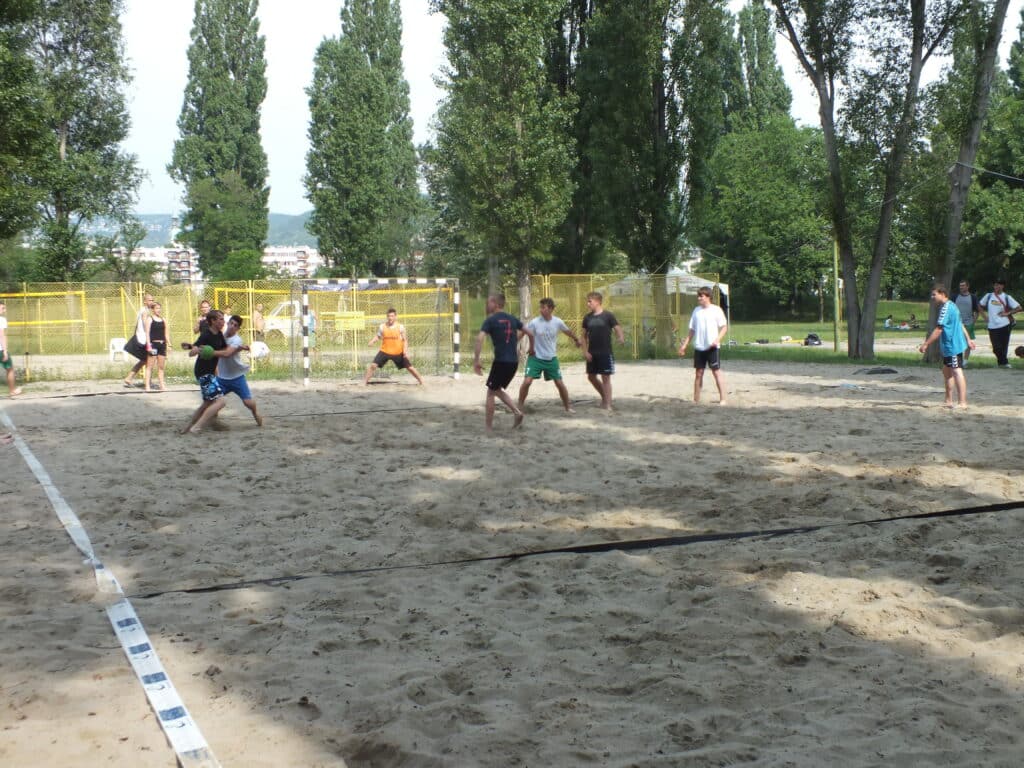
A beach handball court measures 27 by 12 m (88 ft 7 in by 39 ft 4 in), on sand, less than half the floor area of the 40 by 20 m indoor court. The goal stays the same size on both surfaces, 3 m wide and 2 m high, but beach handball marks only one line in front of each goal instead of indoor’s two, and surrounds the whole court with a 3 m safety zone on every side. Every figure below comes from the IHF Rules of the Game for Beach Handball, 3 October 2021, and the IHF Rules of the Game for Indoor Handball already sourced on this site’s indoor handball guide.
Court diagram

The diagram above is the indoor court this guide compares against. Playfield Atlas does not yet have a separate beach handball drawing, so read the drawn lines, including the curved 6-meter arcs, as the indoor format only.
Full beach vs indoor court dimensions
Beach figures come from Rule 1 of the IHF Rules of the Game for Beach Handball. Indoor figures are the ones already verified on this site’s indoor handball court guide, sourced there to Rule 1 of the IHF Rules of the Game for Indoor Handball. Rows marked Derived calculation are computed from the two rulebooks’ own numbers, not printed directly in either document.
| Measurement | Beach | Indoor | Status |
|---|---|---|---|
| Playing court length | 27 m / 88 ft 7 in | 40 m / 131 ft 3 in | Official rule |
| Playing court width | 12 m / 39 ft 4 in | 20 m / 65 ft 7 in | Official rule |
| Playing court area | 324 sq m / 3,488 sq ft | 800 sq m / 8,611 sq ft | Derived calculation |
| Playing surface | Level sand, at least 40 cm (16 in) deep | Flat hard indoor floor | Official rule |
| Safety zone around the court | 3 m / 9 ft 10 in, every side, uniform | 1 m sides, 2 m behind goals, minimum | Official rule |
| Lines in front of each goal | One: a straight 6-meter line only | Two: the curved 6-meter line plus a dashed 9-meter free-throw line | Official rule |
| Goal-area (6-meter) line | Straight line, 6 m from and parallel to the goal line | 3 m flat section plus two 6 m-radius quarter-circle arcs | Official rule |
| Free throw position | Taken from the spot of the infringement, at least 1 m clear of the goal-area line | Taken from the dedicated 9-meter line | Official rule |
| Goal, width x height | 3 m x 2 m / 9 ft 10 in x 6 ft 7 in | 3 m x 2 m / 9 ft 10 in x 6 ft 7 in | Official rule |
| Goalpost and crossbar | Round tubular aluminum, 8 cm (3.1 in) diameter, one solid color | Square section, 8 cm (3.1 in) across, two-color bands | Official rule |
| Goal net depth | 0.8 m top, 1 m bottom / 2 ft 7 in, 3 ft 3 in | 1.0 m top, 1.3-1.5 m bottom / 3 ft 3 in, 4 ft 3 in-4 ft 11 in | Official rule |
| Line width | 5-8 cm / 2.0-3.1 in | 5 cm general, 8 cm goal line / 2.0-3.1 in | Official rule |
Why the beach court is less than half the size
Rule 1:1 of the beach rulebook sets the court at 27 by 12 m, measured from the outer edge of the boundary lines, for 324 sq m of sand. The indoor court this site already covers runs 40 by 20 m, 800 sq m, so the beach format gives up 476 sq m of floor, well over half the indoor court’s area. The two shapes are not simple scale copies of each other either: indoor handball is almost exactly 2 to 1 in length to width, while the beach court’s 27 by 12 m ratio runs closer to 2.25 to 1, a narrower, more elongated rectangle. The indoor handball court guide covers the full 40 by 20 m rectangle this page measures against.
One line in front of goal, not two
Indoor handball draws two lines in front of each goal: the curved 6-meter line and, 3 m further out, a dashed 9-meter free-throw line whose arcs stop short of the side line. Beach handball’s Rule 1:2 draws only one. It describes the goal-area line simply as “6 metres from and parallel to the goal line,” a straight line across the width of each goal area, with no second line and no curved construction mentioned anywhere in the court rule. Free throws on the sand do not use a fixed line at all. Rule 13:8 takes them from the spot where the infringement happened, with a single constraint: if that spot falls less than 1 m from the goal-area line, the throw moves out to that 1-meter mark instead. Indoor free throws, by contrast, come off the dedicated 9-meter line itself.
The goal and its net
The goal opening does not change: 3 m wide and 2 m high on both surfaces, confirmed in Rule 1:4b of the beach rulebook against Rule 1 of the indoor one. What changes is the frame and the net. Beach posts and crossbar are a round tubular aluminum section, 8 cm across, painted a single solid color, yellow, blue or red, the same color on both goals. Indoor posts and crossbar use the same 8 cm measurement but a square cross-section, painted in two-color bands instead of one. The net also hangs differently: beach handball’s Rule 1:4d sets its deepest point at 80 cm at the top and 1 m at the bottom, while indoor’s own dimensioned diagram calls for 1.0 m at the top and 1.3 to 1.5 m at the bottom, a deeper net overall built for a faster-closing indoor goalkeeper to clear.
Sand, safety zone and the gear around the court
Beach handball’s Rule 1:1 requires sand at least 40 cm deep, fine and loosely compacted, free of rocks and shells, with the court itself laid out north-south where possible. Indoor handball simply needs a flat, hard floor, since the surface is never the variable the rulebook has to manage. The space around the lines differs by the same logic: beach handball asks for a uniform 3 m safety zone on every side, while indoor handball’s minimum drops to 1 m along the side lines and 2 m behind the goals. Beach courts also carry catch nets suspended 3 m behind each goal area, 12 m long and 7 m high, and a substitution area 15 m long and about 3 m wide running outside each sideline, built for a sport played without walls or stands pressed close to the lines. The handball hub lists every guide built from these two rulebooks.
Overhead plan
The same surface seen from straight above, drawn to scale. Nothing is foreshortened here, so every figure can be read off the drawing the way a tape measure would take it.

Detail sheet
A rule book fixes more than the shape of the surface, and the rest of it is too small to draw at court scale: a mark a few centimeters long, a post standing a meter off the sideline, the clearance around the whole thing. Each one here has its own frame and its own scale.

Frequently asked questions
Is a beach handball court smaller than an indoor court?
Yes, by a wide margin. The beach court measures 27 by 12 m under Rule 1:1 of the IHF beach rulebook, against 40 by 20 m indoors. That is 324 sq m of sand versus 800 sq m of hard floor, so the beach court gives up 476 sq m, well over half the indoor surface.
Does beach handball have a 9-meter line like indoor handball?
No. Beach handball’s court rule marks only the 6-meter goal-area line, drawn straight and parallel to the goal line. Indoor handball adds a second, dashed 9-meter free-throw line, concentric with the 6-meter line. On the sand, a free throw is instead taken from the spot of the infringement, moved out to at least 1 m from the goal-area line if it would otherwise fall closer.
Is the goal the same size on a beach handball court?
Yes. Both rulebooks set the goal opening at 3 m wide and 2 m high. The frame differs: beach posts and crossbar are round, 8 cm in diameter and a single solid color, while indoor posts and crossbar are square, the same 8 cm measurement, painted in two contrasting color bands.
How deep does the sand need to be on a beach handball court?
At least 40 cm, under Rule 1:1 of the beach rulebook, made of fine, loosely compacted grains and kept free of rocks and shells. The rule also asks for the court to run north-south lengthwise where the venue allows it, to limit how much the setting sun affects play.
How big is the safety zone around a beach handball court?
At least 3 m wide, on every side of the court, under Rule 1:1. That is a uniform figure in every direction. Indoor handball’s minimum is smaller and uneven instead, 1 m along the side lines and 2 m behind the goals.
Official sources
- International Handball Federation, Rules of the Game for Beach Handball, edition 3 October 2021, Rule 1 (The Playing Court), Rule 6 (Goal Area) and Rule 13 (Free Throw).
- International Handball Federation, Rules of the Game for Indoor Handball, edition 1 July 2024, Rule 1, figures reused from this site’s indoor handball court guide, where that document is sourced and linked directly.
Checked against the beach handball rulebook on 3 November 2026. The methodology page explains how each figure is labeled as a rule or a guideline; report an error through corrections.
Photo: Steve Priest via Wikimedia Commons (CC BY 3.0).