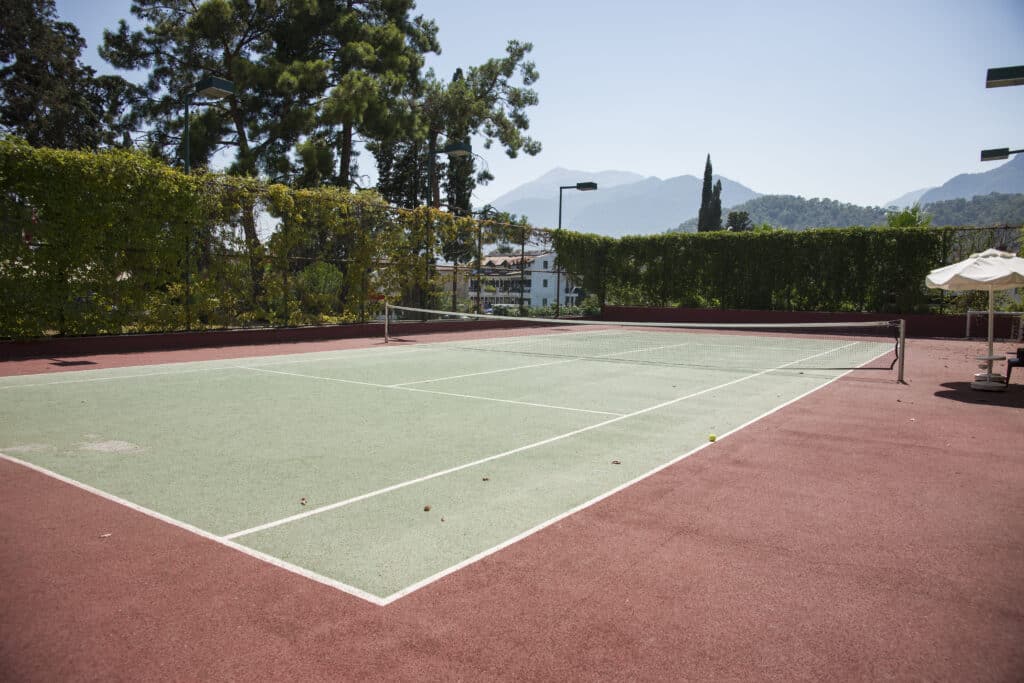
Four pickleball courts fit on a standard tennis court when each one uses USA Pickleball’s 30 ft by 60 ft minimum playing surface, laid two rows deep across a tennis court’s 120 ft by 60 ft competition footprint. A recreational-size tennis court comes up short of that same math by a few feet. The figures below are read from the pickleball and tennis rulebooks already sourced on this site’s court guides, not a new measurement of any specific court.
Court diagram

Full pickleball and tennis court dimensions
The tennis figures come from Rule 1 and Appendix X of the 2026 ITF Rules of Tennis, already cited on the tennis court dimensions guide. The pickleball figures come from Section 3 of the 2026 USA Pickleball Official Rulebook, already cited on the pickleball court dimensions guide. Neither rulebook publishes a fit count for the other sport’s court: the last two rows are this page’s own arithmetic from those official figures.
| Measurement | Figure | Applies to | Status |
|---|---|---|---|
| Tennis court, competition footprint | 120 ft × 60 ft (36.57 m × 18.29 m) | ITF recommended minimum, international competition | Recommendation |
| Tennis court, recreational or club footprint | 114 ft × 56 ft (34.73 m × 17.07 m) | ITF recommended minimum, recreational and club play | Recommendation |
| Pickleball court, minimum playing surface | 30 ft × 60 ft (9.14 m × 18.29 m) | One court, USA Pickleball rule 3.A.3 | Official rule |
| Pickleball court, recommended surface | 34 ft × 64 ft (10.36 m × 19.51 m) | New construction and tournament play | Recommendation |
| Pickleball courts on the competition footprint | 4 | 120 ft footprint length ÷ 30 ft per court width; the 60 ft footprint width matches the pickleball minimum surface length exactly | Derived calculation |
| Pickleball courts on the recreational footprint, minimum surface | 3, with the surface 4 ft short of depth | 114 ft footprint length ÷ 30 ft per court width = 3 rows; the 56 ft footprint width is 4 ft less than the 60 ft minimum surface length each row needs | Derived calculation |
How many pickleball courts fit on a tennis court
The math starts with the space around the lines, not the lines themselves. A pickleball court’s own rectangle is 44 ft by 20 ft, but rule 3.A.3 requires at least 30 ft by 60 ft of surface once run-off is added: 5 ft beyond each sideline and 8 ft behind each baseline. That 30 by 60 ft figure is the unit to divide the tennis footprint by, not the bare court size.
A tennis court built to the ITF’s international-competition footprint measures 120 ft by 60 ft. Dividing the 120 ft length by the pickleball surface’s 30 ft width gives four full rows, and the footprint’s 60 ft width matches the pickleball surface’s 60 ft length with nothing left over. That is where the common answer of four courts comes from, and on this specific footprint the number holds exactly.
A tennis court built only to the ITF’s recreational or club footprint, 114 ft by 56 ft, does not clear the same bar. Dividing 114 ft by 30 ft still gives three rows with 24 ft of width to spare, but the footprint is only 56 ft wide, four feet short of the 60 ft each pickleball surface needs end to end. Fitting four courts, or even three at full standard, means either using the larger competition footprint or trimming the pickleball run-off below the rulebook’s own minimum, which this page does not recommend.
A two-court layout, favored by facilities that want more room per player, uses half of the competition footprint: two 30 ft by 60 ft surfaces placed side by side make a 60 ft by 60 ft square, leaving the other half of the court free. Both layouts still start from the same pickleball hub‘s single court size; only the run-off and the count of courts change.
What changes when the lines overlap
A pickleball court does not land on any existing tennis line. The non-volley zone line sits 7 ft from the net under rule 3.A.4.c; the closest tennis line at that end is the service line, 21 ft from the net. Every pickleball line has to be painted new, whatever the layout.
Rule 3.A.4.e also requires all pickleball lines to be a single color that clearly contrasts with the playing surface. On a court that keeps its tennis lines, that requirement is why converted courts commonly paint the pickleball lines in a second color rather than white: two sets of white lines on the same surface would each fail the rule’s own contrast test against the other.
Net height: what has to change
A tennis net is fixed at 3 ft (0.914 m) at the center and 3 ft 6 in (1.07 m) at the posts, under Rule 1 of the ITF Rules of Tennis. A pickleball net is fixed at 34 in ± 1/4 in (0.8636 m) at the center and 36 in ± 1/4 in (0.9144 m) at the outer edge of its own sideline, under rules 3.B.6 and 3.B.7 of the USA Pickleball Official Rulebook.
At the center, where both rules measure the same point on the net, a tennis net sits 2 in higher than pickleball allows. Neither rulebook lets the other sport’s fixed height stand in for its own, so a court that hosts both games needs a net built to change height, or a separate net moved into place, rather than one fixed net serving both.
Overhead plan
The same surface seen from straight above, drawn to scale. Nothing is foreshortened here, so every figure can be read off the drawing the way a tape measure would take it.

Detail sheet
A rule book fixes more than the shape of the surface, and the rest of it is too small to draw at court scale: a mark a few centimeters long, a post standing a meter off the sideline, the clearance around the whole thing. Each one here has its own frame and its own scale.

Frequently asked questions
How many pickleball courts fit on a tennis court?
Four, if the tennis court is built to the ITF’s international-competition footprint of 120 ft by 60 ft and each pickleball court uses USA Pickleball’s 30 ft by 60 ft minimum surface. A smaller, recreational-size tennis footprint falls short of the depth that math needs.
Can two pickleball courts share a tennis court comfortably?
Yes. Two pickleball courts at the 30 ft by 60 ft minimum surface fit side by side in a 60 ft by 60 ft square, which is half of the ITF competition footprint, leaving the other half of the tennis court open.
Can a tennis net be used for pickleball?
Not at its tennis height. A tennis net sits 2 in higher than pickleball’s rule allows at the center, 3 ft against pickleball’s 34 in. A net built to change height, or a separate net, is needed rather than the fixed tennis net.
Why are pickleball lines on a tennis court usually a different color?
USA Pickleball rule 3.A.4.e requires all pickleball lines to be one color that clearly contrasts with the surface. Since none of the pickleball lines align with the existing tennis lines, a second color keeps the two sets of lines readable against each other.
Does a recreational tennis court have room for full-size pickleball courts?
Not at the ITF’s recreational-footprint minimum of 114 ft by 56 ft. Three 30 ft by 60 ft pickleball surfaces fit across its width, but the footprint is 4 ft short of the depth each one needs, short of the larger competition footprint.
Official sources
- USA Pickleball, 2026 USA Pickleball Official Rulebook, 2026 edition, Section 3, Court and Equipment, rules 3.A and 3.B. Source of every pickleball figure here.
- International Tennis Federation, 2026 Rules of Tennis, Rule 1 and Appendix X. Source of every tennis figure here.
Checked against these documents on 22 September 2026. The methodology page explains how each figure is labeled as a rule or a guideline; report an error through corrections.