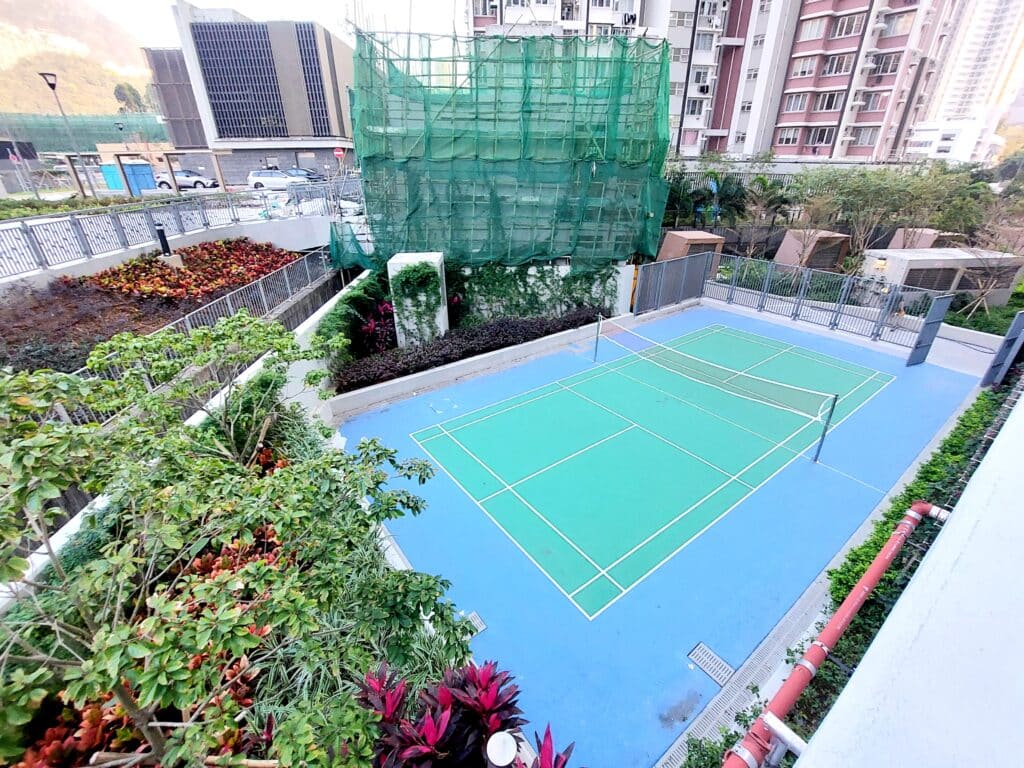
A badminton doubles court and a pickleball court are both 44 ft long and 20 ft wide (13.40 m and 13.41 m by 6.10 m), the same outer rectangle under BWF and USA Pickleball rules. Badminton’s singles court narrows that to 17 ft wide, something pickleball has no equivalent for. The two sports still diverge sharply on net height, how far the service line sits from the net, and line width.
Court diagram

Full badminton and pickleball court dimensions
The badminton figures come from Law 1 of the Badminton World Federation’s Laws of Badminton, already cited on the badminton court dimensions guide. The pickleball figures come from Section 3 of the 2026 USA Pickleball Official Rulebook, already cited on the pickleball court dimensions guide. Neither rulebook compares its sport to the other: the rows marked Derived calculation are this page’s own arithmetic from those official figures.
| Measurement | Figure | Applies to | Status |
|---|---|---|---|
| Badminton doubles court | 44 ft × 20 ft (13.40 m × 6.10 m) | BWF Law 1, doubles | Official rule |
| Badminton singles court | 44 ft × 17 ft (13.40 m × 5.18 m) | BWF Law 1, singles | Official rule |
| Pickleball court | 44 ft × 20 ft (13.41 m × 6.10 m) | USA Pickleball rule 3.A.1, singles and doubles alike | Official rule |
| Outer rectangle, badminton doubles vs. pickleball | 0 ft difference | Both at 44 ft × 20 ft | Derived calculation |
| Badminton net height, center | 5 ft (1.524 m) | BWF Law 1 | Official rule |
| Badminton net height, at the posts | 5 ft 1 in (1.55 m) | BWF Law 1 | Official rule |
| Pickleball net height, center | 34 in ± 1/4 in (86.36 cm) | USA Pickleball rule 3.B.7 | Official rule |
| Pickleball net height, outer edge of sideline | 36 in ± 1/4 in (91.44 cm) | USA Pickleball rule 3.B.6 | Official rule |
| Net height difference, at center | 26 in (0.66 m), badminton higher | 5 ft vs. 34 in | Derived calculation |
| Badminton short service line, from net | 6 ft 6 in (1.98 m) | BWF Law 1 | Official rule |
| Pickleball non-volley zone (kitchen) line, from net | 7 ft (2.13 m) | USA Pickleball rule 3.A.4.c | Official rule |
| Badminton line width | 40 mm (1 1/2 in) | BWF Law 1 | Official rule |
| Pickleball line width | 2 in (5.08 cm) | USA Pickleball rule 3.A.4.e | Official rule |
Where the two courts match exactly
Pickleball’s court was sized to fit inside a badminton doubles court, and the two rulebooks still agree on the outer rectangle: 44 ft long, 20 ft wide, in both. BWF Law 1 sets that width as the doubles boundary, measured to the outer side lines; USA Pickleball rule 3.A.1 sets the same 20 ft width for every format of pickleball, since the sport has no separate singles sidelines at all. Lay one court’s outer lines over the other’s and they land in the same place.
That match stops at the outer rectangle. Nothing inside it lines up: badminton’s short service line, center line, and doubles long service line sit at different distances from the net than pickleball’s non-volley zone line and center line, and the two sports use different line widths. A court built for one sport does not come with the other sport’s lines already in the right place.
Net height: the biggest functional difference
A badminton net sits 5 ft (1.524 m) high at the center and 5 ft 1 in (1.55 m) at the posts, which rest on the doubles side lines. A pickleball net sits 34 in (86.36 cm) high at the center and 36 in (91.44 cm) at the outer edge of each sideline, both with a quarter-inch tolerance. At the center, where both rulebooks measure the same point on the net, badminton’s net stands 26 in (0.66 m) higher.
The gap exists because the games ask different things of the net. Badminton’s shuttlecock is hit on steep, often near-vertical arcs, so a low net would do nothing to shape the rally. Pickleball’s paddle and ball stay closer to waist height, and a net at badminton’s height would turn most shots into a dead stop. Neither rulebook lets the other sport’s fixed height stand in: a shared court needs a net built to change height, or two separate nets, not one net left at either setting.
Service line vs. kitchen line
Badminton’s short service line runs 6 ft 6 in (1.98 m) from the net on each side, under Law 1. A legal serve has to clear that line to land in. Pickleball’s non-volley zone line, the edge of the court’s kitchen, runs 7 ft (2.13 m) from the net on each side, under rule 3.A.4.c. The two lines are 6 in apart, and they do different jobs: badminton’s line only governs where a serve may land, while pickleball’s kitchen line marks ground where no player may volley the ball at any point in the rally, serve or not.
That difference in purpose matters more than the 6 in gap. A badminton player can stand on the short service line’s far side and smash from well inside it once the rally starts; a pickleball player who steps on or inside the kitchen line to volley a ball out of the air faults on the spot, under rule 3.A.4.c, no matter how the rally got there.
Singles court: where pickleball has no equivalent
Badminton narrows for singles. Law 1 drops the width from the 20 ft doubles boundary to 17 ft, using the inner side lines instead of the outer ones, while the court’s 44 ft length and the net stay the same. The 1 ft 6 in (460 mm) strips outside those inner lines, left unused in singles, are the doubles alleys described on the badminton court guide.
Pickleball draws no such line. Rule 3.A.1 sets one 44 ft by 20 ft court for singles and doubles alike, and the sport’s hub page confirms no narrower boundary exists in the rulebook. A badminton court repainted for pickleball keeps its full 20 ft width for every match; a pickleball court has never needed a singles version to lose in the first place.
Overhead plan
The same surface seen from straight above, drawn to scale. Nothing is foreshortened here, so every figure can be read off the drawing the way a tape measure would take it.

Detail sheet
A rule book fixes more than the shape of the surface, and the rest of it is too small to draw at court scale: a mark a few centimeters long, a post standing a meter off the sideline, the clearance around the whole thing. Each one here has its own frame and its own scale.

Frequently asked questions
Are a badminton court and a pickleball court the same size?
Their outer rectangles match: both are 44 ft by 20 ft. That is badminton’s doubles court specifically; badminton’s singles court narrows to 17 ft wide, a boundary pickleball does not have in any format.
What is the net height difference between badminton and pickleball?
26 in (0.66 m) at the center: badminton’s net sits at 5 ft (1.524 m), pickleball’s at 34 in (86.36 cm). At the posts, badminton rises to 5 ft 1 in while pickleball’s net reaches 36 in at the outer edge of each sideline, a different reference point.
How far is pickleball’s kitchen line compared to badminton’s short service line?
Pickleball’s non-volley zone line sits 7 ft from the net; badminton’s short service line sits 6 ft 6 in from the net, 6 in closer. The lines also serve different purposes: one limits where a serve may land, the other bars volleys for the whole rally.
Does pickleball have a singles court like badminton?
No. USA Pickleball rule 3.A.1 sets the same 44 ft by 20 ft court for singles and doubles. Badminton is the sport with two widths: 20 ft for doubles, 17 ft for singles.
Can a badminton court be reused for pickleball?
The outer rectangle already matches a badminton doubles court, so no resize is needed there. The net still has to drop by 26 in at the center, and the service and kitchen lines sit at different distances from the net, so new lines and an adjustable or separate net are needed either way.
Official sources
- Badminton World Federation, Laws of Badminton, Law 1: The Court, BWF Statutes Section 4.1, in force 26 April 2025 (Version 5.0). Source of every badminton figure here.
- USA Pickleball, 2026 USA Pickleball Official Rulebook, 2026 edition, Section 3, Court and Equipment, rules 3.A and 3.B. Source of every pickleball figure here.
Checked against these documents on 10 November 2026. The methodology page explains how each figure is labeled as a rule or a guideline; report an error through corrections.
Photo: Knowledge Era via Wikimedia Commons (CC BY-SA 4.0).