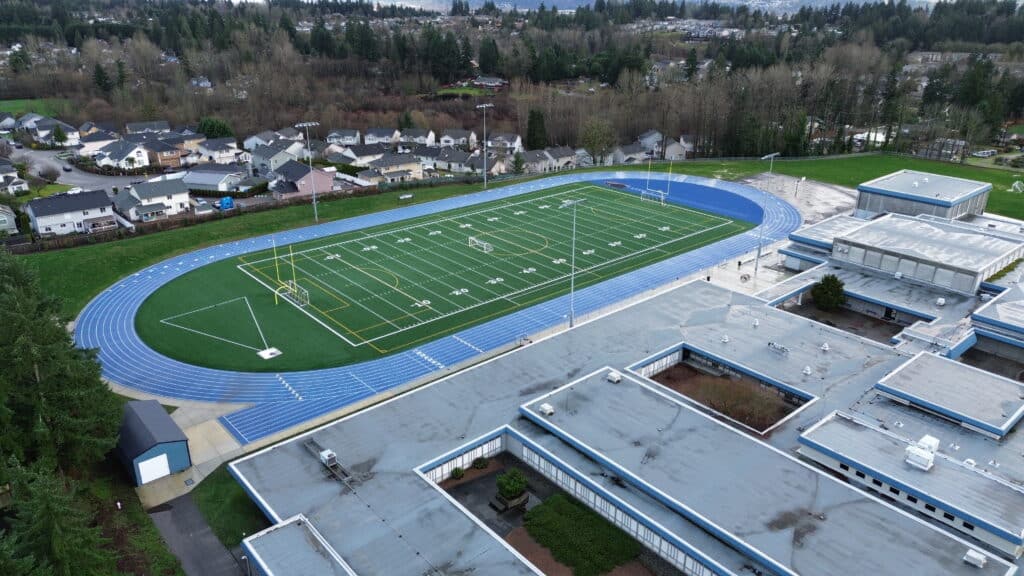
Marking a football field starts by squaring the full 360 by 160 ft rectangle, sideline to sideline and end line to end line, before a single hash mark or goal line goes down: that outer rectangle’s diagonal measures 393 ft 11 in (120.08 m). Every interior marking, from the hash marks to the goal posts, is then measured from that squared perimeter using the same NFL, NCAA and NFHS offsets already sourced on this site’s football field dimensions guide.
Field diagram

Start from the official dimensions, not a guess
Every figure below comes from the NFL, NCAA and NFHS rule books already sourced on this site’s football field dimensions guide, part of the American football hub. The three diagonal rows are not printed in any of those rule books; they are calculated from those same official dimensions with the Pythagorean theorem and labeled as derived calculations.
| Measurement | Figure | Applies to | Status |
|---|---|---|---|
| Overall rectangle, end line to end line and sideline to sideline | 360 ft x 160 ft (109.73 m x 48.77 m) | NFL, NCAA, NFHS | Official rule |
| Full rectangle diagonal (squaring check) | 393 ft 11 in (120.08 m) | NFL, NCAA, NFHS | Derived calculation |
| Field of play diagonal, goal line to goal line (squaring check) | 340 ft (103.63 m) | NFL, NCAA, NFHS | Derived calculation |
| End zone rectangle diagonal, goal line to end line (squaring check) | 162 ft 9 in (49.62 m) | NFL, NCAA, NFHS | Derived calculation |
| Hash mark distance from sideline, NFL | 70 ft 9 in (21.56 m) | NFL | Official rule |
| Hash mark distance from sideline, NCAA | 60 ft (18.29 m) | NCAA | Official rule |
| Hash mark distance from sideline, NFHS | 53 ft 4 in (16.26 m) | NFHS | Official rule |
| Line width, general | 4 in (10.2 cm) | NFL, NCAA, NFHS | Official rule |
| Line width, NFL goal line | 8 in (20.3 cm) | NFL | Official rule |
Set the perimeter before marking any inside line
A rectangle this size is easier to lay out from its four corners than by chasing one line at a time. Stake one goal line first, at the chosen width, then run a string line from each end toward the opposite goal line, holding each string at a right angle to the goal line (checked with the 3-4-5 method below). Measure the full 360 ft sideline length along each string to fix the two far corners, then connect them to form the opposite goal line. Only after all four corners are set should the two sidelines and two end lines themselves be strung and painted.
Once the four corners are fixed, measure both full diagonals, corner to opposite corner. On a regulation 360 by 160 ft field, each should read 393 ft 11 in (120.08 m). If the two diagonals don’t match each other, the rectangle isn’t square yet, even when all four sides already measure 360 and 160 ft on their own; a leaning parallelogram can have the right side lengths and still be crooked.
The 3-4-5 check for each corner
Before a sideline is run out to its full length, confirm the angle at each corner is a true right angle with a 3-4-5 triangle: measure 3 ft along one line from the corner and 4 ft along the line that should meet it at a right angle, then measure the distance between those two points. On a true right angle, that third side is exactly 5 ft. Doubling those numbers to 6, 8 and 10 ft, or further, gives a longer baseline and a more precise check once the lines are staked further out. This is a general property of right triangles, not a rule from any of the three codes, and it catches a crooked corner before a full sideline is run out (the same check, at the same 3-4-5 ratio, is used on this site’s guide to lining a soccer field).
Placing the hash marks
The hash marks are where the three codes part ways, and where a lining crew most often mixes up which set of numbers to use. Run a chalk or string line parallel to each sideline, at the sideline offset the chosen code uses, for the full length of the field of play; the hash marks themselves are then painted as short dashes crossing that line at 1-yard intervals. NFL fields put that line 70 ft 9 in from each sideline, leaving 18 ft 6 in between the two rows. NCAA fields put it 60 ft out, leaving a 40 ft gap. NFHS fields put it 53 ft 4 in out, splitting the 160 ft width into three equal 53 ft 4 in bands instead of a narrow center lane.
None of these three offsets interchange. A crew lining a high school field from an NFL diagram would place the hash marks more than 17 ft too far inside, and a crew lining an NFL field from NCAA numbers would miss by nearly 11 ft. Confirm which code’s field is being marked before the first hash line goes down.
Goal posts and the end zone line
The end line, 30 ft behind each goal line, marks the back of the end zone. Squaring that end zone rectangle uses the same diagonal method as the outer field, just applied to the smaller 30 by 160 ft box; its own diagonal should read 162 ft 9 in (49.62 m), corner to corner. Checking it on its own catches an end zone that drifted out of square even when the full field diagonal still measures correctly.
The goal itself stands on the end line, not the goal line, with the crossbar 10 ft above the ground in all three codes. Width is where the codes split again: the inside of the uprights sits 18 ft 6 in apart in the NFL and the NCAA, and 23 ft 4 in apart under NFHS rules, so a goal post set built for one code does not fit squarely on a field marked for another.
Overhead plan
The same surface seen from straight above, drawn to scale. Nothing is foreshortened here, so every figure can be read off the drawing the way a tape measure would take it.

Detail sheet
A rule book fixes more than the shape of the surface, and the rest of it is too small to draw at court scale: a mark a few centimeters long, a post standing a meter off the sideline, the clearance around the whole thing. Each one here has its own frame and its own scale.

Frequently asked questions
What is the first line to mark on a football field?
The perimeter rectangle: the two sidelines and two end lines. Every interior marking, including the hash marks, yard lines and goal posts, is measured from a sideline, a goal line or the end line, so the outer rectangle has to be square before any of them go down.
How do I check that a football field is marked square?
Measure both full diagonals, corner to opposite corner. On a regulation 360 by 160 ft field, each should read 393 ft 11 in (120.08 m); if the two diagonals don’t match each other, the field isn’t square yet, even when every side already measures 360 or 160 ft on its own.
Why do NFL, NCAA and NFHS hash marks sit at different distances from the sideline?
Each code sets its own offset instead of sharing one. The NFL uses 70 ft 9 in (21.56 m), leaving 18 ft 6 in (5.64 m) between the two rows. The NCAA uses 60 ft (18.29 m), leaving a 40 ft (12.19 m) gap. The NFHS uses 53 ft 4 in (16.26 m), which splits the field’s width into three equal bands instead of a narrow center lane.
How wide apart are football goal posts?
18 ft 6 in (5.64 m) inside to inside in the NFL and the NCAA, and 23 ft 4 in (7.11 m) in NFHS high school play. A crew building a set of goal posts needs to know which code’s field it is marking before cutting the crossbar.
Does the end zone change the squaring check?
Yes, slightly. The end zone is its own 30 by 160 ft rectangle, and its diagonal should read 162 ft 9 in (49.62 m), separate from the full field’s 393 ft 11 in diagonal. Checking both catches an end zone that drifted out of square even when the overall rectangle still measures correctly corner to corner.
Official sources
- National Football League, Official Playing Rules of the NFL, 2026 edition, Rule 1.
- National Collegiate Athletic Association, NCAA Football Rules and Interpretations, 2026 edition, Appendix D.
- National Federation of State High School Associations, Football Field Diagram, 11-player Football Field, 2026 edition.
Every dimension above was already read from these documents for this site’s football field dimensions guide; the diagonal checks here are new calculations from those same official figures, done with exact arithmetic and checked against the published hash mark and goal post numbers on 29 October 2026. The methodology page explains how each figure is labeled as a rule or a derived calculation; report an error through corrections.