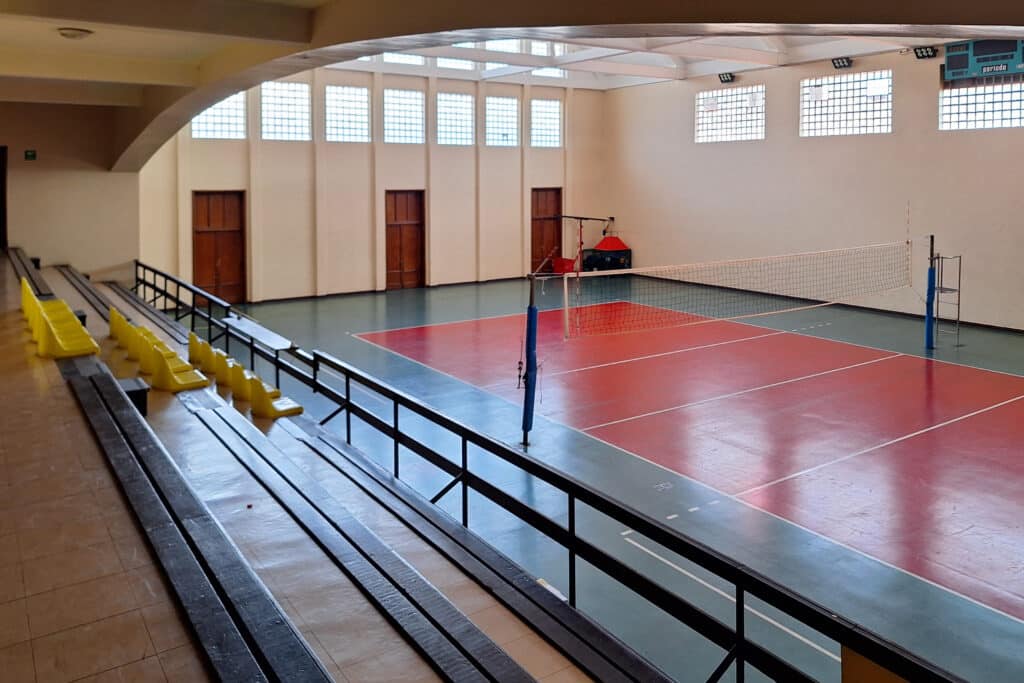
Marking a volleyball court means transferring the FIVB’s 18 by 9 m rectangle onto the floor, not inventing a layout from scratch. Every line is 5 cm (1.97 in) wide: two side lines, two end lines, a center line under the net, and an attack line 3 m (9 ft 10.1 in) back from it on each side. A 9 m-wide service zone sits behind each end line, and the full court diagonal, 20.12 m (66 ft 0.3 in) corner to corner, proves the rectangle is square before any paint dries.
Court diagram


Full court marking dimensions
Every figure below comes from Rule 1 of the FIVB Official Volleyball Rules 2025-2028, already sourced on this site’s volleyball court dimensions guide. The two diagonal rows are not printed in the rulebook. They are calculated from the court’s own 18 by 9 m dimensions with the Pythagorean theorem and labeled as derived calculations, not rules.
| Measurement | Figure | Applies to | Status |
|---|---|---|---|
| All court lines, width | 5 cm (1.97 in) | All indoor play | Official rule |
| Side and end lines, placement | Drawn inside the 18 x 9 m rectangle | All indoor play | Official rule |
| Center line | Splits the court into two 9 x 9 m halves; the full line width belongs to both | All indoor play | Official rule |
| Attack line, rear edge from the center line axis | 3 m (9 ft 10.1 in) | All indoor play | Official rule |
| Attack line extension | Five 15 cm dashes, 5 cm wide, 20 cm apart, 1.75 m (5 ft 8.9 in) total | FIVB, World and Official Competitions | Official rule |
| Service zone width | 9 m (29 ft 6.3 in), behind each end line | All indoor play | Official rule |
| Service zone, lateral limit lines | Two 15 cm lines, 20 cm behind the end line | All indoor play | Official rule |
| Substitution zone | Bounded by the extension of both attack lines to the scorer’s table | All indoor play | Official rule |
| Libero replacement zone | Part of the free zone on the bench side, bounded by the attack line extended to the end line | All indoor play | Official rule |
| Full court diagonal (squaring check) | 20.12 m (66 ft 0.3 in) | All indoor play | Derived calculation |
| Half-court diagonal, each 9 x 9 m half (squaring check) | 12.73 m (41 ft 9.1 in) | All indoor play | Derived calculation |
Boundary, center and attack lines
Rule 1.3.1 sets every line on the court at 5 cm wide, in a light color that must differ from the floor and from every other line. Rule 1.3.2 places the two side lines and two end lines inside the 18 by 9 m rectangle, so the painted boundary is part of the playing surface rather than a border around it; a ball landing on the line is in.
The center line runs under the net from side line to side line. Rule 1.3.3 splits the court into two equal 9 by 9 m halves along the axis of that line, but gives the entire width of the paint to both halves equally, so neither side loses playing surface to the stripe itself. For the full set of figures this line connects to, including net height and free zone, see the volleyball court dimensions guide, where that method is also used to mark and square a complete court.
Each attack line marks the front zone. Rule 1.3.4 draws its rear edge 3 m back from the axis of the center line, on both sides of the net. At FIVB, World and Official Competitions the line is extended past each side line with five short dashes, each 15 cm long and 5 cm wide, spaced 20 cm apart, for a combined extension length of 1.75 m. That extension is a competition-level marking, not required on a recreational court.
Mark the service, substitution and Libero zones
The service zone is a 9 m-wide strip behind each end line, where the serving team puts the ball in play. Rule 1.4.2 limits it laterally with two short lines, each 15 cm long, drawn 20 cm behind the end line as an extension of the side lines; both short lines count as part of the service zone’s width, not as separate markings. In depth, the service zone is not boxed in: it runs to the end of the free zone around the court.
Two more zones are marked by extending lines that already exist, rather than by painting anything new. Rule 1.4.3 limits the substitution zone to the space between the extension of both attack lines, running out to the scorer’s table. The Libero replacement zone, on the bench side of the court, is bounded the same way: by the attack line extended out to the end line, inside the free zone. Neither needs its own painted border beyond the attack line. The volleyball hub lists every guide built from these rules.
Square the court with the diagonal check
Four correct side lengths do not guarantee a square court; a rectangle can lean into a parallelogram while every side still measures 18 or 9 m. The reliable check is the diagonal, measured corner to corner. Using the Pythagorean theorem on the court’s own 18 by 9 m dimensions gives a diagonal of 20.12 m (66 ft 0.3 in). If a measured diagonal does not match that figure, at least one corner is out of square, even if every side line reads correctly.
A builder marking the two 9 by 9 m halves separately, working outward from the center line, can square each half on its own first: that half-court diagonal is 12.73 m (41 ft 9.1 in). Both figures are derived calculations, not numbers printed in the FIVB rulebook, and neither substitutes for measuring the sides; a diagonal check only confirms right angles once the side lengths are already correct.
Surface and line color requirements
Rule 1.2.1 requires a flat, horizontal, uniform surface free of injury risk; rough or slippery surfaces are forbidden outright. For FIVB, World and Official Competitions, Rule 1.2.2 allows only a wooden or synthetic surface, previously approved by the FIVB. Indoors, the playing court must be a light color, and at FIVB competitions the lines must be white, with the playing court and the free zone in different colors from each other; the playing court may also use two colors to separate its own front and back zones.
Rule 1.2.3 allows a drainage slope of 5 mm per meter on outdoor courts only, never indoors, and forbids court lines made of any solid material, such as tape laid over an uneven base, on either surface. These rules apply to hard indoor and outdoor volleyball courts; a sand court follows a separate set of FIVB rules with no center line at all, covered on this site’s beach vs. indoor volleyball court guide.
Overhead plan
The same surface seen from straight above, drawn to scale. Nothing is foreshortened here, so every figure can be read off the drawing the way a tape measure would take it.

Detail sheet
A rule book fixes more than the shape of the surface, and the rest of it is too small to draw at court scale: a mark a few centimeters long, a post standing a meter off the sideline, the clearance around the whole thing. Each one here has its own frame and its own scale.

Frequently asked questions
How wide are the lines on a volleyball court?
Rule 1.3.1 sets every line on the court, boundary and center alike, at 5 cm (1.97 in) wide. Each line must be a light color that is different from the floor and from every other line on it, so no two lines on the same court share a color.
How far is the attack line from the center line?
Rule 1.3.4 draws the rear edge of the attack line 3 m (9 ft 10.1 in) back from the axis of the center line, on both sides of the net. Since the net stands over the center line, that same 3 m is also the depth of the front zone on each side.
How wide is the service zone on a volleyball court?
The service zone is 9 m (29 ft 6.3 in) wide, matching the width of the court, and sits behind each end line. Rule 1.4.2 limits it laterally with two 15 cm lines drawn 20 cm behind the end line, and lets it extend in depth to the outer edge of the free zone.
How do you check that a volleyball court is marked square?
Measure the full diagonal, corner to corner. On an 18 by 9 m court it should read 20.12 m (66 ft 0.3 in); on a single 9 by 9 m half, 12.73 m (41 ft 9.1 in). Matching side lengths alone do not prove the corners are square, only equal diagonals do.
Does a beach volleyball court use the same markings as an indoor court?
No. A beach court drops the center line entirely and uses just two side lines and two end lines, laid in webbing or tape over sand rather than painted. The service zone, substitution zone and surface rules described here apply only to hard indoor and outdoor courts; see the beach vs. indoor comparison for the sand court’s own figures.
Official sources
- Fédération Internationale de Volleyball (FIVB), Official Volleyball Rules 2025-2028, Rule 1 Playing Area (1.2 Playing Surface, 1.3 Lines on the Court, 1.4 Zones and Areas). 2025-2028 edition, approved by the 39th FIVB World Congress 2024, in force in all competitions beginning after 1 January 2025. Consulted 13 October 2026.
Diagonal measurements checked against these dimensions on 13 October 2026. Photo: Carlos Figueroa Rojas via Wikimedia Commons (CC BY-SA 4.0). The methodology page explains how each figure is labeled as a rule or a derived calculation; report an error through corrections.