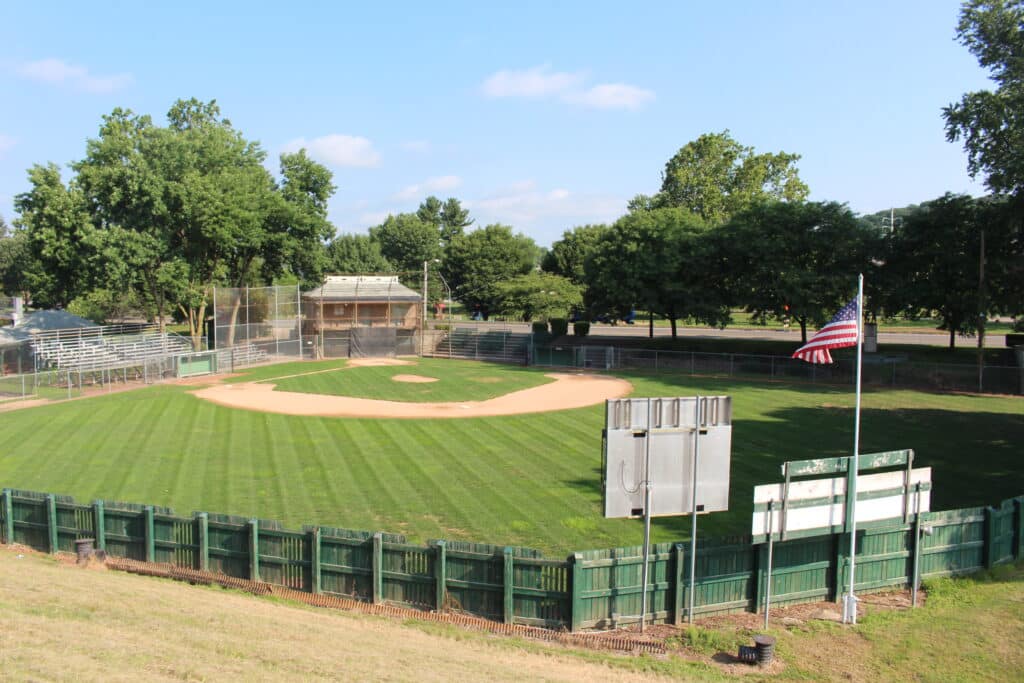
Little League field dimensions by age run from a 50 to 60-foot diamond for Tee Ball (league age 4-7) up to the full 90-foot base path used in Senior League (13-16). In between, the Intermediate (50/70) and Junior League divisions each get their own shortened base path and pitching distance. Every figure below comes from Little League International’s own field specifications and league age chart, read on 22 October 2026.
Field diagram

Little League field dimensions by division
Every figure below comes from Little League Baseball, Incorporated’s Field Specifications and League Age Chart pages, except the Major Division pitching distance, which is reused from this site’s baseball field guide, already sourced to the Little League Rules Instruction Manual. The diagram above is drawn at the standard 90-foot scale; it does not shrink to match the smaller Tee Ball, Minor League, Major Division, Intermediate (50/70) or Junior League base paths compared below.
| Measurement | Figure | Applies to | Status |
|---|---|---|---|
| Base path, standard (12-year-olds and below) | 60 ft (18.29 m) | Tee Ball, Minor League, Major Division; league age 4-12 | Official rule |
| Base path, Tee Ball local option | 50 ft (15.24 m) | Tee Ball; league age 4-7 | Recommendation |
| Pitching distance, Major Division | 46 ft (14.02 m) | Major (“Little League”) Division; league age 9-12 | Official rule |
| Base path, 13-year-old baseball standard | up to 90 ft (27.43 m) | Intermediate (50/70), Junior League, Senior League; league age 11-16 | Official rule |
| Base path, Intermediate (50/70) local option | 70 ft (21.34 m) | Intermediate (50/70); league age 11-13 | Recommendation |
| Base path, Junior League local option | 75 ft (22.86 m) | Junior League; league age 12-14 | Recommendation |
| Pitching distance, Junior and Senior League standard | 60 ft 6 in (18.44 m) | Junior League, Senior League; league age 12-16 | Official rule |
| Pitching distance, Intermediate (50/70) local option | 50 ft (15.24 m) | Intermediate (50/70); league age 11-13 | Recommendation |
| Pitching distance, Junior League local option | 54 ft (16.46 m) | Junior League; league age 12-14 | Recommendation |
| Outfield fence, Major Division and below | 200 ft (60.96 m) | Tee Ball, Minor League, Major Division | Recommendation |
| Outfield fence, Intermediate (50/70) | 200 ft (60.96 m) | Intermediate (50/70) | Recommendation |
| Outfield fence, Junior and Senior League | 300 ft (91.44 m) | Junior League, Senior League | Recommendation |
From Tee Ball to the Majors: how the 60-foot diamond holds
Little League’s field specifications state that the distance between base paths for 12-year-olds and below is generally 60 feet (18.29 m), which covers Tee Ball, Minor League and the Major Division in one line. A local board can still opt into a smaller 50-foot (15.24 m) diamond for Tee Ball, where the youngest players, league age 4 to 7, are not yet covering real ground between bases. Minor League, league age 7 to 12, keeps the 60-foot square regardless of whether the pitch comes from a coach, a machine or a player.
The Major Division, informally “Little League” Division, is where the 60-foot square gets a fixed pitching distance: 46 feet (14.02 m), for league age 9 to 12. That figure, and the Major Division’s base path, are the same ones already documented in full on this site’s baseball field dimensions guide, alongside the professional and NFHS numbers it sits next to.
Intermediate (50/70) and Junior League: two different shortened distances
Little League’s field specifications treat every division played by 13-year-olds as using a base path of up to 90 feet (27.43 m), with a pitching distance of up to 60 feet 6 inches (18.44 m). Two divisions get a published local-league option to shorten both: Intermediate (50/70) Baseball, league age 11 to 13, can play a 70-foot (21.34 m) base path with 50-foot (15.24 m) pitching, which is where the division’s “50/70” name comes from. Junior League Baseball, league age 12 to 14, has its own separate option: a 75-foot (22.86 m) base path with 54-foot (16.46 m) pitching.
Both are described as local league options “for regular season play,” not as fixed rules every league must adopt. A league that skips the option plays the full 90-foot, 60-foot-6-inch dimensions in both divisions, so a field built to the shortened figures is not interchangeable with one built to the full standard without moving the mound and bases.
Senior League: back to the full 90-foot diamond
Senior League Baseball, league age 13 to 16, falls inside the specifications page’s “13-year-old baseball” base-path statement, so its base path is up to 90 feet (27.43 m). Its pitching distance is grouped with Junior League in the same sentence: 60 feet 6 inches (18.44 m). Unlike Intermediate (50/70) and Junior League, the field specifications page does not name a published local-option shortening for Senior League, so the division is built, and typically played, at the full distances used in Major League Baseball and NFHS play. The same square-corner layout and diagonal check described in how to build a baseball diamond apply at this full 90-foot distance.
Why the outfield fence is a recommendation, not a rule
Little League states plainly that the distance from home plate to the outfield fence is a local league option, then lists recommended distances: 200 feet (60.96 m) for the Major Division and below, 200 feet (60.96 m) for Intermediate (50/70), and 300 feet (91.44 m) for Junior and Senior League. None of these numbers is enforceable the way a base path or pitching distance is; a field can be built shorter or longer and still host sanctioned play. Readers comparing fields across a league’s full age range, covered more broadly on the baseball hub, should treat the fence figures as planning guidance rather than a pass or fail measurement.
Overhead plan
The same surface seen from straight above, drawn to scale. Nothing is foreshortened here, so every figure can be read off the drawing the way a tape measure would take it.

Detail sheet
A rule book fixes more than the shape of the surface, and the rest of it is too small to draw at court scale: a mark a few centimeters long, a post standing a meter off the sideline, the clearance around the whole thing. Each one here has its own frame and its own scale.

Frequently asked questions
What age is Little League’s Major Division?
Players of league age 9 to 12 are eligible for the Major (“Little League”) Division. It plays on the standard 60-foot (18.29 m) base path used by every division of 12-year-olds and below, with a 46-foot (14.02 m) pitching distance.
What does “50/70” mean in Little League?
It names the Intermediate (50/70) Baseball Division’s local-option distances: a 50-foot (15.24 m) pitching distance and a 70-foot (21.34 m) base path, for league age 11 to 13, shorter than the full 60-foot-6-inch and 90-foot figures the specifications page allows for that age group.
How far are the bases in Junior League Baseball?
Up to 90 feet (27.43 m), the same as Senior League and professional baseball, with a local league option to shorten the base path to 75 feet (22.86 m) and the pitching distance to 54 feet (16.46 m) for regular season play. League age for Junior League is 12 to 14.
Is Senior League played on a full-size baseball field?
Yes. Senior League, league age 13 to 16, uses the full 90-foot (27.43 m) base path and 60-foot-6-inch (18.44 m) pitching distance. Little League’s field specifications do not publish a shortened local option for this division, unlike Junior League and Intermediate (50/70).
Can a local league use a smaller Tee Ball diamond?
Yes. Little League’s field specifications state that a local board of directors may opt to use a 50-foot (15.24 m) diamond in the Tee Ball divisions, league age 4 to 7, instead of the standard 60-foot (18.29 m) base path shared with Minor League and the Major Division.
Official sources
- Little League Baseball, Incorporated, Field Specifications, current page.
- Little League Baseball, Incorporated, Determine League Age, current page (league age ranges and age determination date).
- Major League Baseball / Office of the Commissioner of Baseball, Official Baseball Rules, 2025 Edition, Rule 2.04 (Major Division pitching distance, already verified for this site’s baseball field dimensions guide).
The two Little League International pages were checked against the live site on 22 October 2026. The methodology page explains how each figure is labeled as a rule or a guideline; report an error through corrections.
Photo: Ruhrfisch via Wikimedia Commons (CC BY-SA 3.0).