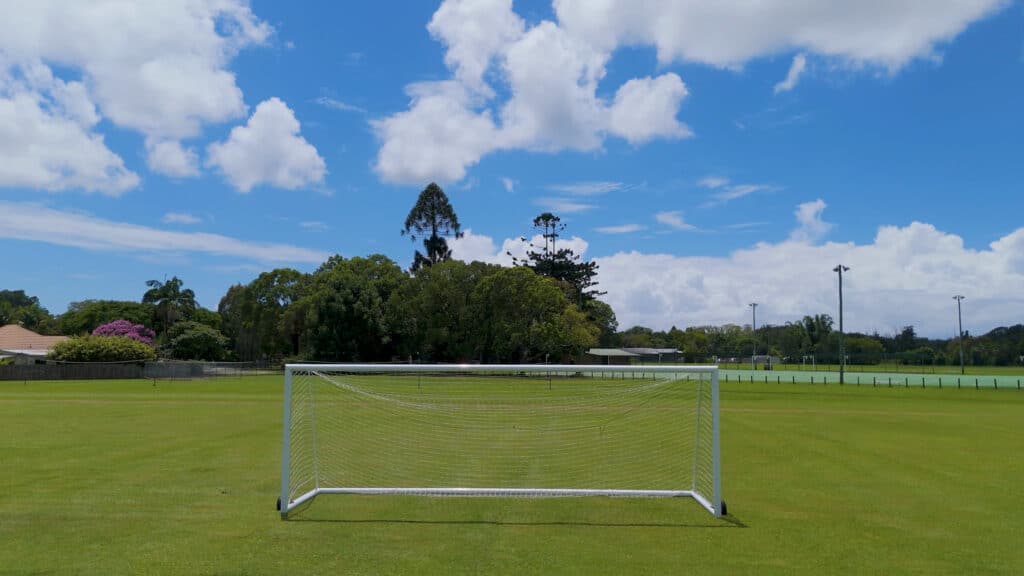
Youth soccer uses three official field sizes below the full 11v11 pitch: a 25-35 by 15-25 yard 4v4 field for U6 through U8, a 55-65 by 35-45 yard 7v7 field for U9 and U10, and a 70-80 by 45-55 yard 9v9 field for U11 and U12. These are U.S. Soccer’s own Player Development Initiatives standards, mandated nationwide since August 2017, and each format also sets its own goal size, ball size and offside rule.
Field diagram

Full field dimensions by age group
The diagram above is this site’s full-size, adult soccer field; U.S. Soccer has not published an official diagram for any small-sided layout, so every figure below comes straight from the Small-Sided Games Chart in U.S. Soccer’s Player Development Initiatives, the national standard mandated for member organizations since August 2017. Yards lead because that is the chart’s own unit.
| Age group | Field length | Field width | Maximum goal size | Ball size | Status |
|---|---|---|---|---|---|
| U6, U7, U8 (4v4, no goalkeeper) | 25-35 yd (22.86-32.00 m) | 15-25 yd (13.72-22.86 m) | 4 ft x 6 ft (1.22 x 1.83 m) | Size 3 | Official standard |
| U9, U10 (7v7, with goalkeeper) | 55-65 yd (50.29-59.44 m) | 35-45 yd (32.00-41.15 m) | 6.5 ft x 18.5 ft (1.98 x 5.64 m) | Size 4 | Official standard |
| U11, U12 (9v9, with goalkeeper) | 70-80 yd (64.01-73.15 m) | 45-55 yd (41.15-50.29 m) | 7 ft x 21 ft (2.13 x 6.40 m) | Size 4 | Official standard |
4v4 fields for U6, U7 and U8
At 4v4, the field tops out smaller than a basketball court: 25 to 35 yards long and 15 to 25 yards wide, with no goalkeeper and no offside rule at any point on it. Goals are capped at 4 feet high by 6 feet wide, small enough that a coach can carry a pair to the sideline. U.S. Soccer’s standard also drops corner flags entirely at this level and calls for a size 3 ball, the same ball used through U8.
Because there is no goalkeeper, there is also no goal area or penalty area to mark out. The whole point of the small field is to put every player within a few steps of the ball; U.S. Soccer’s own standard describes four quarters of up to 10 minutes rather than two halves, with unlimited substitutions at any stoppage.
7v7 fields and the build-out line for U9 and U10
The 7v7 field jumps to 55-65 yards by 35-45 yards, roughly four times the area of the largest 4v4 field, and adds a goalkeeper for the first time. U.S. Soccer’s standard calls for a 6.5 by 18.5 foot maximum goal, though it recommends a smaller 6.5 by 12 foot goal based on the players’ age and ability, and a size 4 ball.
The format’s defining feature is the build-out line, drawn equidistant between the penalty area line and the halfway line on each half. When the goalkeeper has the ball, the opposing team must retreat behind that line before the keeper restarts play by passing, throwing or rolling it; a punt or drop kick is not allowed and gives the other team an indirect free kick instead. The build-out line also marks where offside applies: there is no offside offense between the halfway line and the build-out line, only between the build-out line and the goal line. U.S. Soccer’s standard also bans heading outright in 7v7 play, at any point on the field, with an indirect free kick as the penalty for a head touch, deliberate or not.
9v9 fields for U11 and U12
9v9 is the bridge format: a 70-80 by 45-55 yard field, a maximum goal of 7 by 21 feet (6.5 by 18.5 feet recommended), a size 4 ball and eight field players plus a goalkeeper per side. U.S. Soccer’s standard drops the build-out line at this level; offside applies across the whole attacking half instead, the same way it works on a full-size pitch.
The heading rule narrows rather than disappears: U.S. Soccer’s standard bans heading in 9v9 play for U11 only, not U12, with the same indirect free kick penalty as 7v7. After U12, players move up to the full 11v11 field covered in the soccer field dimensions guide, where heading is unrestricted and the field grows again, this time to FIFA’s 105 by 68 meter recommendation.
How the three sizes compare
Stacking the three ranges against the 105 x 68 m (7,140 m²) field used on the main soccer hub shows how gradually the game actually scales up. Each area figure below is our own arithmetic on the official length and width ranges, not a number U.S. Soccer publishes directly.
| Format | Field area range | Share of a full-size 105 x 68 m pitch | Status |
|---|---|---|---|
| 4v4 (U6-U8) | 314-732 m² | about 4% to 10% | Derived calculation |
| 7v7 (U9-U10) | 1,610-2,446 m² | about 23% to 34% | Derived calculation |
| 9v9 (U11-U12) | 2,634-3,679 m² | about 37% to 52% | Derived calculation |
Even the largest 9v9 field covers barely more than half of a full-size pitch, which is one reason the jump to 11v11 at U13 feels so big to players coming off a 9v9 season.
Overhead plan
The same surface seen from straight above, drawn to scale. Nothing is foreshortened here, so every figure can be read off the drawing the way a tape measure would take it.

Detail sheet
A rule book fixes more than the shape of the surface, and the rest of it is too small to draw at court scale: a mark a few centimeters long, a post standing a meter off the sideline, the clearance around the whole thing. Each one here has its own frame and its own scale.

Frequently asked questions
What size field does a 7v7 soccer team play on?
55 to 65 yards long and 35 to 45 yards wide, under U.S. Soccer’s Player Development Initiatives for U9 and U10. The goal is no larger than 6.5 by 18.5 feet, though a smaller 6.5 by 12 foot goal is recommended for players at that age.
Does 9v9 soccer use a build-out line?
No. The build-out line is a 7v7 feature for U9 and U10 only. At 9v9, U.S. Soccer’s standard removes it and applies offside across the entire attacking half, the same way a full 11v11 field does.
Can players head the ball in 9v9 games?
Not at U11. U.S. Soccer’s standard bans heading in 9v9 play for U11 only; a head touch, deliberate or not, is penalized with an indirect free kick. The same document does not extend that ban to U12 9v9 play.
When do youth players move to a full 11v11 field?
At U13, after two seasons of 9v9 at U11 and U12. From that point the field, goal and ball sizes follow the same standards used in adult play, covered in this site’s main soccer field dimensions guide.
Are these field sizes mandatory for every youth league?
U.S. Soccer mandated the small-sided standards for its member organizations starting August 2017. A local league or state association can still publish its own field-size memo within those ranges, so two U11 fields built to this standard will not always share the exact same footprint.
Official sources
- U.S. Soccer, Player Development Initiatives (Small-Sided Games Chart and Standards of Play), mandated for member organizations as of August 2017. Field, goal and ball size ranges, build-out line rules and heading restrictions for 4v4, 7v7 and 9v9.
Checked against that document on 2 October 2026. The methodology page explains how each figure is labeled as a rule or a guideline; report an error through corrections.