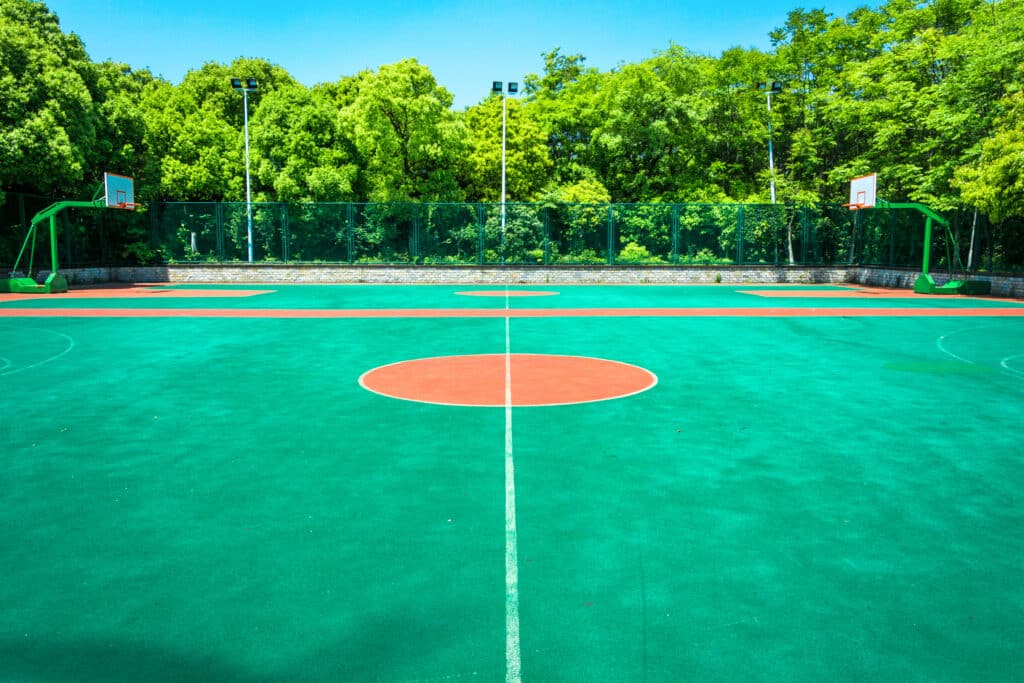
Official 3×3 basketball court dimensions are 15 m by 11 m, or 49 ft 2.6 in by 36 ft 1.1 in, built around a single basket instead of two. The free-throw line sits 5.80 m from the basket and the two-point arc is drawn at 6.75 m, the same distance FIBA uses for its full-court three-point line. At 165 m² (1,776 sq ft), the whole court is smaller than half of a regulation NBA or NCAA court.

The court drawing above this paragraph is the full 94 by 50 ft NBA layout used throughout this site’s basketball guides, not a 3×3 half-court. A 3×3 court keeps the same free-throw lane, restricted-area arc, and basket height as a full court; it just stops at one end line instead of two.
Official 3×3 basketball court dimensions
These figures come from the FIBA 3×3 Official Basketball Rules, approved by the FIBA Central Board on 4 December 2025 and valid as of 1 January 2026. Rows marked Derived calculation are area figures worked out from the published lengths, not separately published by FIBA.
| Measurement | Figure | Applies to | Status |
|---|---|---|---|
| Playing court | 15 m x 11 m 49 ft 2.6 in x 36 ft 1.1 in | FIBA 3×3, all levels | Official rule |
| Free-throw line, from basket | 5.80 m 19 ft 0.3 in | FIBA 3×3 | Official rule |
| Two-point line (arc) | 6.75 m 22 ft 1¾ in | FIBA 3×3 | Official rule |
| Playing court area | 165 m² 1,776 sq ft | FIBA 3×3 | Derived calculation |
| Recommended outdoor footprint | 18 m x 14 m 59 ft 0.7 in x 45 ft 11.2 in | FIBA 3×3 outdoor venues | Official rule |
| Clear space beyond the court | 2.0 m typical, 1.0 m minimum 6 ft 6.7 in / 3 ft 3.4 in | FIBA 3×3 outdoor venues | Official rule |
How a 3×3 court compares to a full or half court
A common shortcut describes 3×3 as “half of a regulation court,” and the two do look similar at a glance since both are built around one basket. The actual numbers do not match. An NBA or NCAA half court, measured from the division line to the end line, is 47 by 50 ft, or 2,350 sq ft, as covered in the full basketball court dimensions guide. A FIBA 3×3 court is 165 m², which converts to 1,776 sq ft. That is around 600 sq ft less than an NBA half court, not because the free-throw area shrinks, but because 3×3 drops roughly 8 ft of width and backcourt depth that a 5-on-5 half still carries.
The gap is easy to miss because both layouts share the same lane, restricted-area arc, and rim height. What changes is how much open floor sits beyond the arc: a 3×3 court simply does not need the backcourt space a 5-on-5 half court keeps for inbounding and advancing the ball.
Why FIBA calls it the two-point line
In 5-on-5 FIBA basketball, the arc at 6.75 m is the three-point line. In 3×3, baskets made from inside that same arc count for one point and baskets from beyond it count for two, so FIBA’s 3×3 rulebook calls the line the two-point line instead. The distance itself is not a new measurement: it is the identical 6.75 m arc already used on a full FIBA court, just renamed for a scoring system built around 1s and 2s rather than 2s and 3s.
The free-throw line follows the same logic in reverse. FIBA 5-on-5 sets it 5.80 m from the basket, and 3×3 keeps that exact distance. A player fouled during a two-point attempt shoots two free throws from that line; a player fouled on a one-point attempt shoots one.
Rim height and ball size stay the same
A 3×3 basket is not lowered or moved. The rim sits 10 ft, or 3.05 m, above the floor, matching every other FIBA, NBA, NCAA, and WNBA format covered in the site’s basketball hub. The ball is the one unusual piece of equipment: FIBA 3×3 uses a ball with the circumference of a size 6 ball but the weight of a size 7 ball, a specification that does not carry over from the full-court size chart.
Footprint and clearance for an outdoor court
FIBA’s venue guide recommends an 18 by 14 m footprint for an outdoor 3×3 court, well beyond the 15 by 11 m playing surface itself. That extra margin, 2.0 m of clear space on a full-sized build, is meant to keep players who chase a loose ball off the fence line and away from the backstop support. Where a site cannot spare that much room, FIBA’s guidance allows the clearance behind the basket to shrink to 1.0 m from the support pole to the end line, though that is described as a constrained-space minimum, not the preferred layout.
None of this margin is painted onto the court. It is empty concrete or synthetic surface around the boundary lines, planned in before construction rather than marked during it.
Overhead plan
The same surface seen from straight above, drawn to scale. Nothing is foreshortened here, so every figure can be read off the drawing the way a tape measure would take it.

Detail sheet
A rule book fixes more than the shape of the surface, and the rest of it is too small to draw at court scale: a mark a few centimeters long, a post standing a meter off the sideline, the clearance around the whole thing. Each one here has its own frame and its own scale.

Frequently asked questions
Is a 3×3 basketball court the same size as a half court?
No. They look alike because both use one basket, but a FIBA 3×3 court is 15 by 11 m, or 1,776 sq ft, while an NBA or NCAA half court is 47 by 50 ft, or 2,350 sq ft. The 3×3 court is about 600 sq ft smaller.
What are the 3×3 basketball court dimensions in feet?
The official 15 by 11 m court converts to 49 ft 2.6 in by 36 ft 1.1 in. FIBA publishes the rule in meters; the feet-and-inches figures are a direct conversion, not a separate US measurement.
How far is the 3×3 two-point line from the basket?
6.75 m, or 22 ft 1¾ in, measured the same way as FIBA’s full-court three-point arc. Shots from inside that line score one point in 3×3; shots from beyond it score two.
Is the 3×3 free-throw line different from a regular FIBA court?
No. Both use 5.80 m from the basket. 3×3 did not shorten the free-throw distance; it reused the existing FIBA 5-on-5 figure.
How much space do I need to build an outdoor 3×3 court?
FIBA’s venue guide recommends an 18 by 14 m footprint, which includes 2.0 m of clear space around the 15 by 11 m playing court. A constrained site can reduce that to a 1.0 m minimum behind the backstop, but that is a fallback figure, not the preferred size.
Official sources
- FIBA 3×3 Official Basketball Rules, approved by the FIBA Central Board 4 December 2025, valid as of 1 January 2026, Article 2 (Playing court).
- FIBA Venue Guide, Outdoor Courts and Facilities, for the recommended footprint and boundary clearance.
Checked against those documents on 6 October 2026. The methodology page explains how each figure is labeled as a rule or a guideline; report an error through corrections.